

Photo of cerulean warbler by Joshua Wiley.
Doubling the Size of
Tobacco Barn Hollow
Total Project Cost: $2,768,730
Balance Needed: ONLY $8420 remaining!!!!
Hiking: Sunrise to Sunset
Addresses for Both Trailheads:
700 Ewing Rd, Bainbridge, OH 45612;
6870 Morgans Fork Rd, Waverly, OH 45690
Download and Go! - Hiking Guide and More Information
A dog owner's guide to hiking the Arc of Appalachia
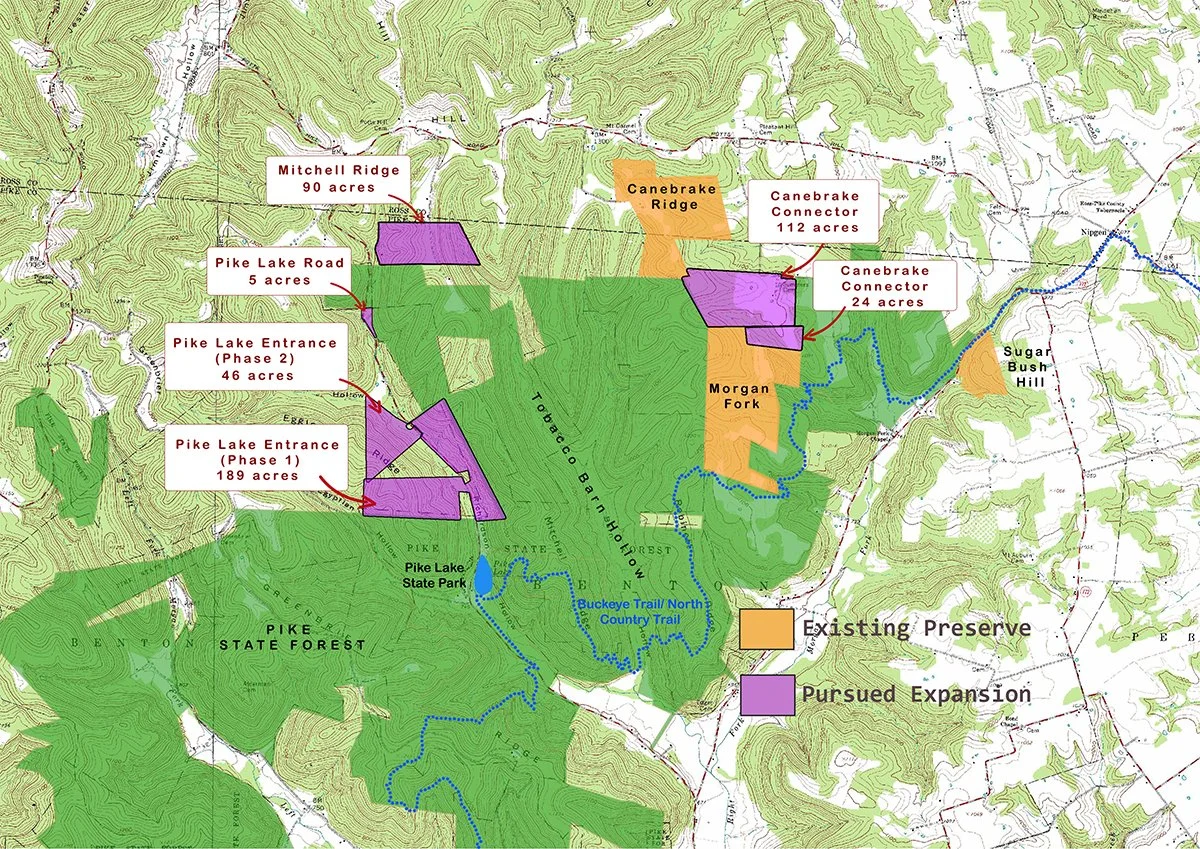
This is the second-largest campaign for Ohio forest preservation in the Arc’s 30-year history! Our goal is to DOUBLE the acreage of Tobacco Barn Hollow Preserve, increasing it from its current 458 acres to 927!! We were already working on one major parcel in the region, funded heavily by a Clean Ohio grant, when, in the span of just a few months last winter, we were contacted by FIVE additional landholders who wanted to sell their land to us, many of them hoping their forests would be permanently preserved.
What are the odds of this real estate activity in one place—and all at the same time? We were stunned by the synchronicity of these opportunities. If this plan succeeds, Tobacco Barn Hollow will become the Arc’s SECOND LARGEST preserve in Ohio, exceeded in size only by the Highlands Nature Sanctuary. We are stunned by how this campaign has come together against all odds!
Backer Barn Hollow, as we call it locally, spans the shared border of Ohio’s Ross and Pike Counties in the remote, roadless heartland of 12,500-acre Pike State Forest. Nestled between Mitchell and Robinette Ridges, the region boasts a dramatic 500-foot elevation change from ridgetop to the valley floor.
Only FOUR viable populations of timber rattlesnakes remain in Ohio. Tobacco Barn Hollow is one of them. Multiple sightings of the endangered timber rattlesnake have been documented on both state land and our preserve. Without large blocks of protected forested wilderness, this beautiful, shy, and unassuming reptile has no chance whatsoever for survival. In our pursuit to expand home territory for this species, we are also creating a future for the endangered. Naturally, many other wildlife species will benefit from the protection of such a large and contiguous chunk of forest, especially since we will be permitting these woodlands to age and mature without timber removal or any other disturbance.
Scroll below the photo gallery and the acquisition map for a detailed map of the preserve.
For funding details regarding this campaign, scroll below the photo gallery for deeper information.
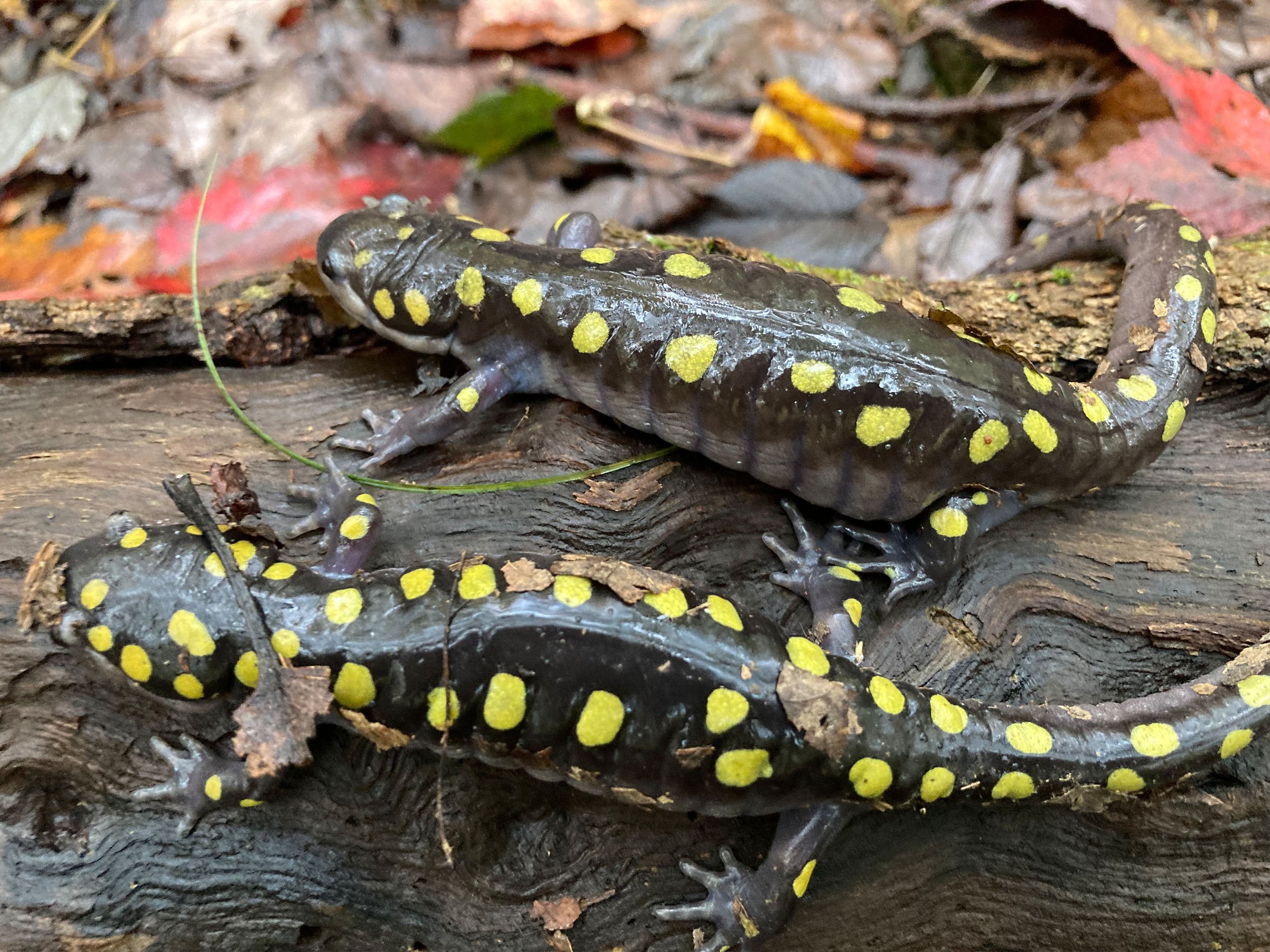

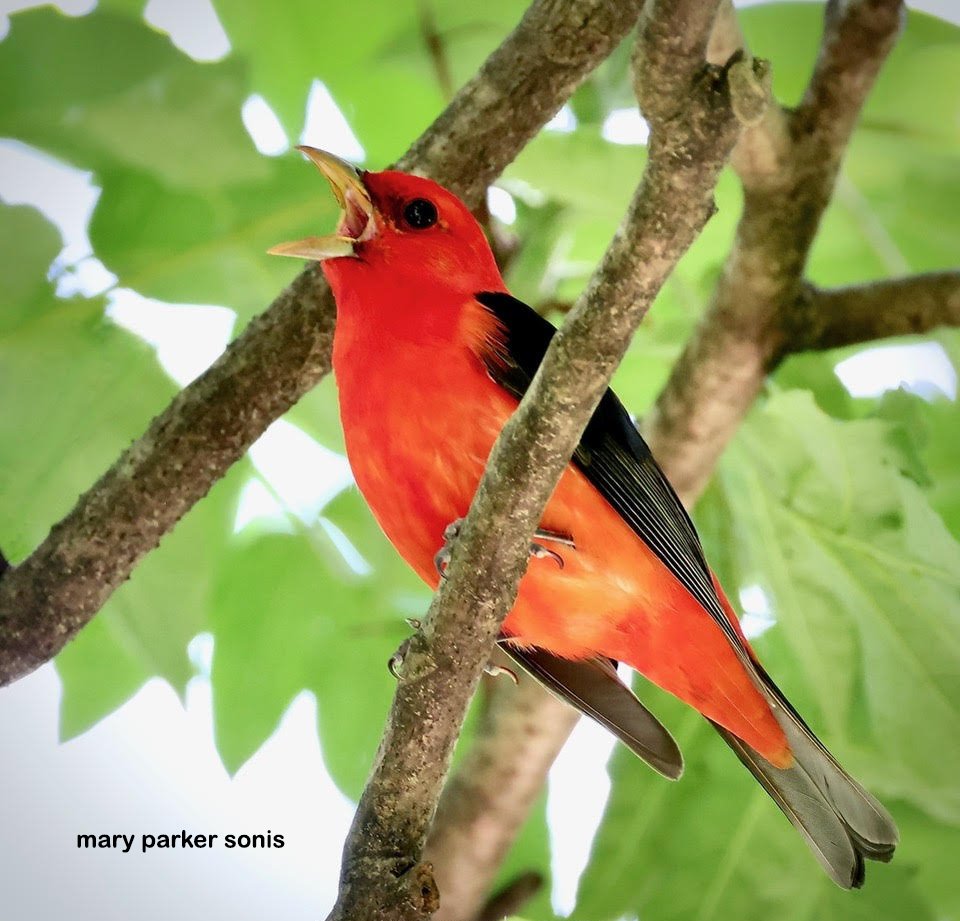

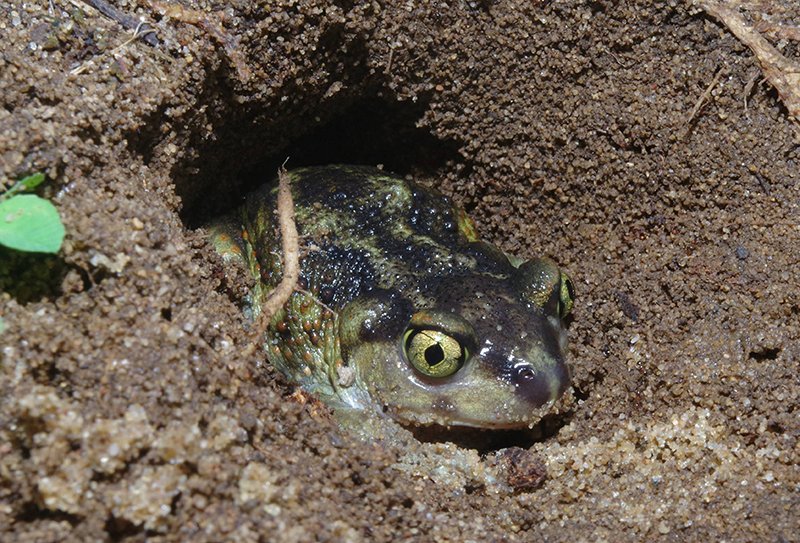

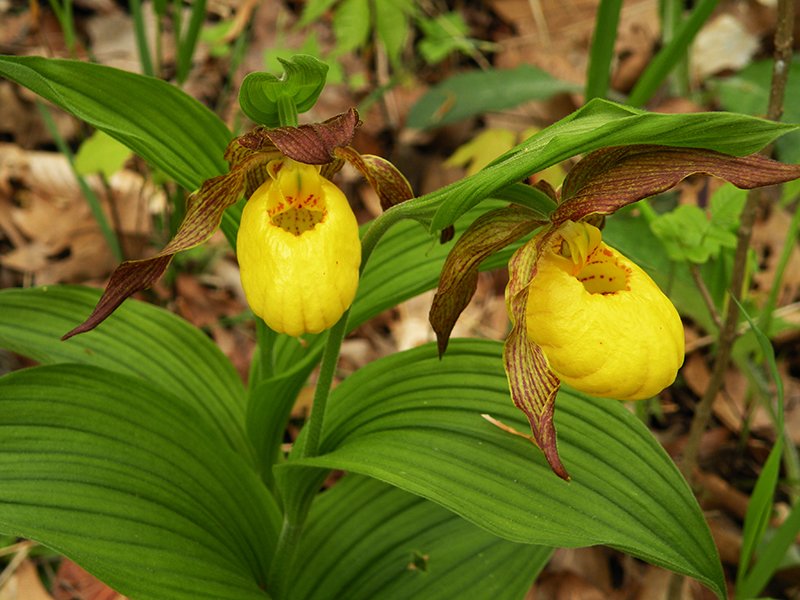
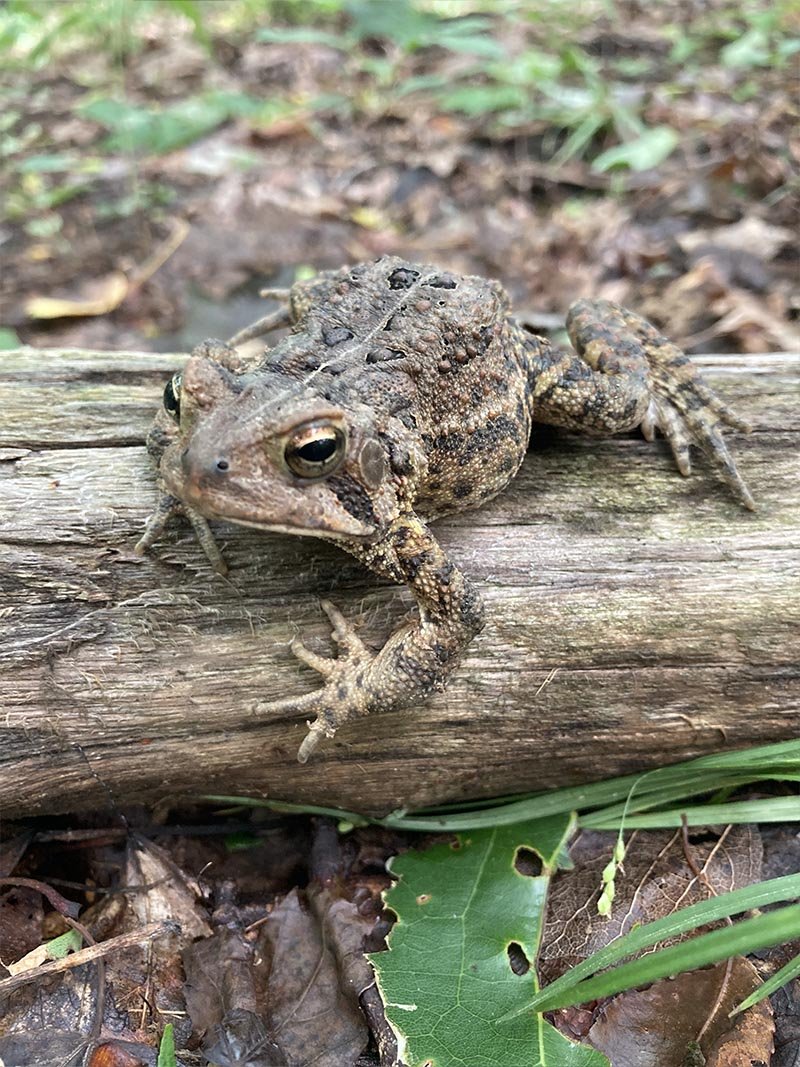


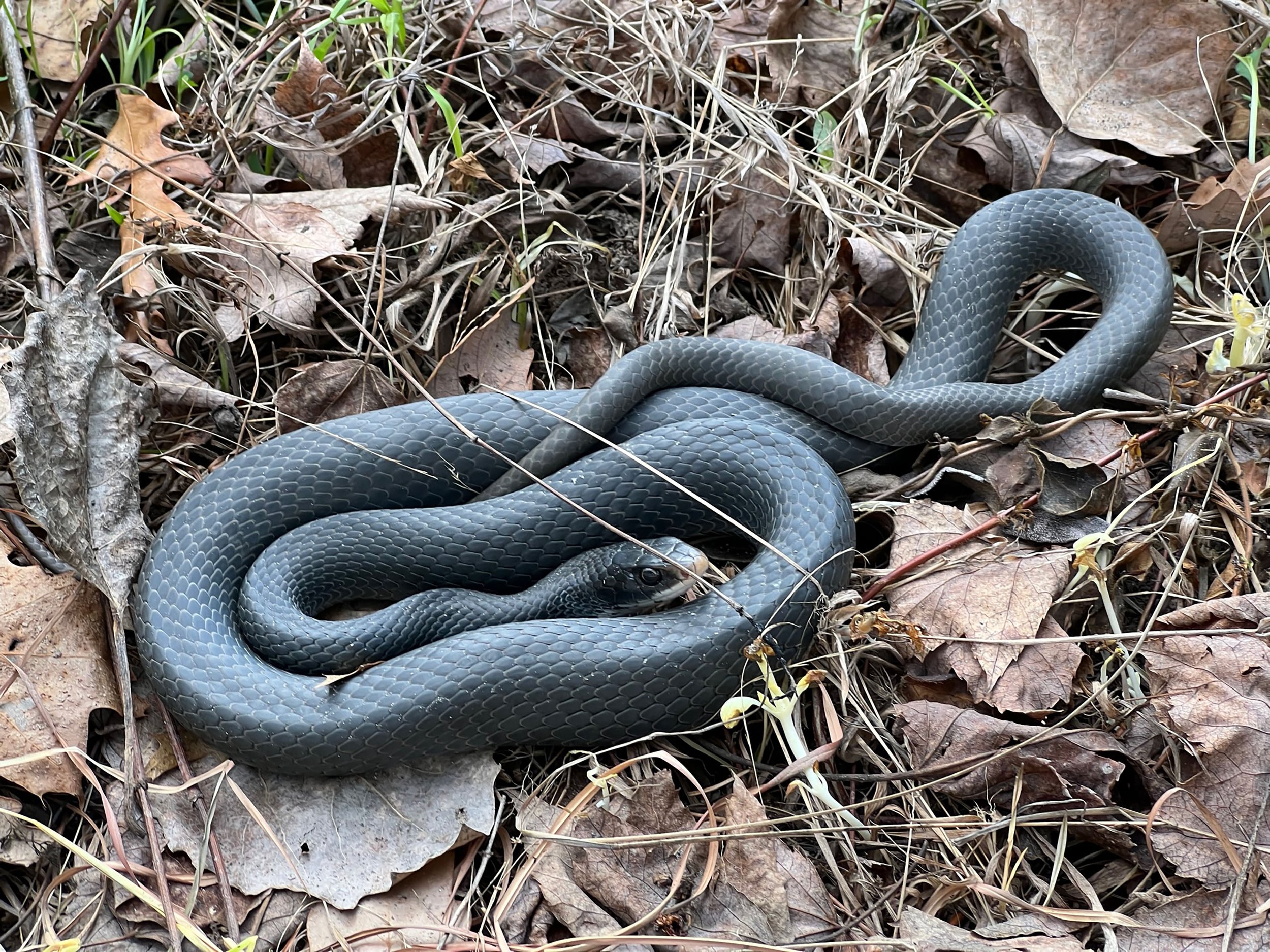


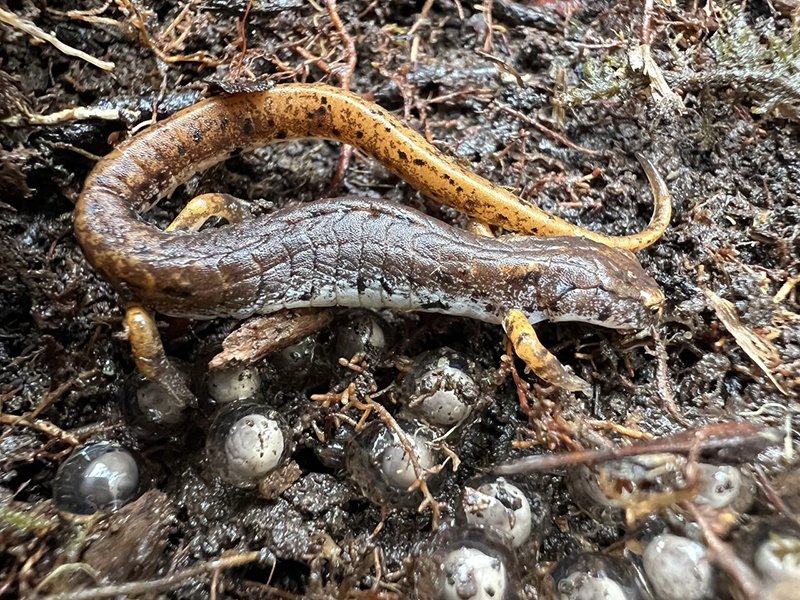


Preserving a Wilderness for Biodiversity. Forest fragmentation and destruction are two of the leading causes of biodiversity decline across America’s Great Eastern Hardwood Forest. The larger an intact forest community, the better it can nurture its primeval complex of plants and animals. Large, old forests equate to high biodiversity. The Arc’s primary purpose for founding Tobacco Barn Hollow in 2007 was to provide homes for some of Ohio’s most vulnerable wildlife species. Today, 18 years later, we wish to expand it in size for the very same reasons.
Herp “Central.” Tobacco Barn Hollow has the greatest diversity of amphibians and reptiles of any preserve in the Arc of Appalachia properties. Tobacco Barn Hollow is not only a documented refuge for timber rattlesnakes, but it also provides a safe harbor for many other reptiles as well, including gray rat snakes, rough green snakes, black racers, and ring-necked snakes, to name a few. Timber rattlesnakes have been intensely studied at Tobacco Barn Hollow Preserve over the years by expert field researchers. By marking individuals with small tracking devices and then laboriously following them around all summer, a remarkable amount of information has been gleaned about their seasonal behaviors. We’ve learned how far a snake will cover ground in a season, where it hibernates, and what perils present themselves throughout the year. Several specimens of timber rattlesnakes have been found crossing the very lands that we are currently pursuing for acquisition.
Tobacco Barn Hollow is equally rich in amphibian diversity. Vernal pools teem with life in early spring at a time when mole salamanders, newts, and wood frogs play out their ancient breeding rituals. The rarest amphibian discovery that has been made in the preserve has been the state-endangered eastern spadefoot toad. Multiple records of these extremely rare animals have been found on existing preserve lands, but where these animals are actually breeding remains a mystery.
Botanical Hotspot. On one of the parcels, which has only recently been added to the campaign, Arc staff members were delighted to discover the densest wildflower display we have ever witnessed on soils derived from sandstone and shale bedrocks. Dense displays of celandine poppy, sweet William phlox, perfoliate bellwort, Jack-in-the-pulpit, green dragon, long-spurred violet, and large-flowered trillium dominate the dense carpets of flowers. In early summer, stunning towers of Canada lilies unfurl into bloom. Tobacco Barn Hollow’s floral diversity and bounty rival the flower showcases of the Arc’s karst-country preserves, which is really saying something!
We Speak for the Birds! Preserving habitat for breeding birds on both ends of their arc of migration is now an urgent necessity if we are not to witness the tragedy of a rapidly approaching Silent Spring. The population of North American birds has dropped nearly 30% since 1970,which equates to a staggering loss of three billion birds. Because the word “billion” is beyond our comprehension, considering the losses of specific species helps drive this point home. Since 1970, we have lost 168 million dark-eyed juncos, 93 million white-throated sparrows, and 139 million meadowlarks. Roughly one out of every four birds that shared our world back in 1970 has vanished into thin air. These missing birds are the “canaries in the coal mine” for planet Earth. Their deaths demonstrate that the life force of our planet’s ancient, natural communities - including our Eastern Forest - is flickering out as it loses its ability to sustain abundance and biodiversity.
All of the bird migrants that winter in the tropics and nest in the deep forests of the Eastern United States - from scarlet tanagers to hooded warblers and wood thrushes - have significantly better breeding success when provided with large, intact blocks of forests. This is where their insect food reserves are the most secure, and where the threat of parasitic cowbirds laying eggs in their nests is minimized. Thus, all of our forest birds benefit from the Tobacco Barn Hollow project - our vireos, tanagers, gnatcatchers, and warblers. But the birds that will benefit the most are those that don’t just prefer large blocks of forests to reproduce successfully, they require them. Signature deep forest birds include worm-eating warblers, ovenbirds, cerulean warblers, and Kentucky warblers. All of these species can be found in high numbers in the forests of Tobacco Barn Hollow, and they will especially benefit from our planned forest protection in the region.
Funding Status for the Property.
Fantastic Grant News. In November of 2025, the Arc was awarded its second grant submission to the Clean Ohio program for the expansion of Tobacco Barn Hollow, shooting up our progress thermometer. We are delighted to report that, thanks to your generous donations and to the awards of two phases of Clean Ohio grants, the $2,768,730 campaign is now only $125,000 away from the finish line and 99% complete!
Frequently Asked Questions
What expenses are covered by the campaign?The campaign total includes the sale price, closing costs, and a small percentage (7% or less) to cover the cost of preparing the closing papers, running the campaign, pursuing grant sources, and processing gifts and checks. All of this is accomplished in-house with our Arc staff. Stewardship funds are not included in this campaign and will be raised separately. For more information on how the Arc stewards its preserves, follow this link: “Stewardship Forever.”
Can I visit the property?YES! Tobacco Barn Hollow is currently being developed with trails, and some of them are already open. More trails are planned for the campaign properties, along with the Buckeye Trail/North Country Trail running right through the preserve region. Be sure to subscribe to our news services to receive announcements of future trail openings via email and through Telegram, a phone app, by clicking this Subscribe button.
Is the Arc a trustworthy nonprofit? The answer is YES (naturally, we are just a wee bit biased, but for good reasons)! Our dynamic staff and committed board are all dedicated to integrity, honesty, efficiency, hard work, and transparency. Our best reviews are from our donors, nearly all of whom stay with us long-term. Many who supported us when the Arc started 30 years ago are still part of our extended family of donors. For those of you interested in fiscal data, our 2024 audited financials are linked to our donation page. We invite you to read more about our mission here, and check out our recent annual news magazines - an annual celebration of the Arc’s energized land preservation achievements, combined with some truly splendid nature art. We hope you will also consider visiting us at our headquarters, the 3,000-acre Highlands Nature Sanctuary in south-central Ohio, where we have 18 miles of trails and overnight rental cabins.
Would you like to contact us? Phone our office staff at (937) 365-1935, or write toarcpreserveinfo@gmail.com. Our headquarters at the Appalachian Forest Museum is hosted by REAL people (amazing, right?), 7 days a week from March 15 to November 15. During the winter, our phones and emails are staffed Monday through Friday.
Something in this campaign has your name on it. Let us help you find it! Each of us has a unique network. Each of us is separated from every other human being on the planet by no more than six handshakes. Okay, that may be a slight exaggeration, but it is a lovely assertion of our interconnectedness. If you would like to share campaign news with circles of connection, know that our front door is wide open to help you help us. We delight in putting broken lands back together again and removing the fences between them. And you know what? We feel exactly the same way about people.
Welcome Citizen Naturalists!. We have created iNaturalist projects for each of our open preserves! If you would like to review, contribute, or comment on the species list at Tobacco Barn Hollow, you can do so here.